
AI use of your IP happens inside your rules.
An operating system for IP in the controlled-AI era.
受控 AI 时代的 IP 运营体系。

- 01Protect保护
Fingerprint monitoring across platforms. Takedown evidence with watermarks.
- 02Create生产
AI derivative content inside guardrail rules. Every asset through a review queue.
- 03Monetize变现
Licensed engines, channel programs, revenue attribution back to the IP owner.
- 04Foundation底座
The rulebook itself: character sheets, style constraints, escalation paths.
围栏规则 · 监修队列 · 水印存证 · 指纹监测
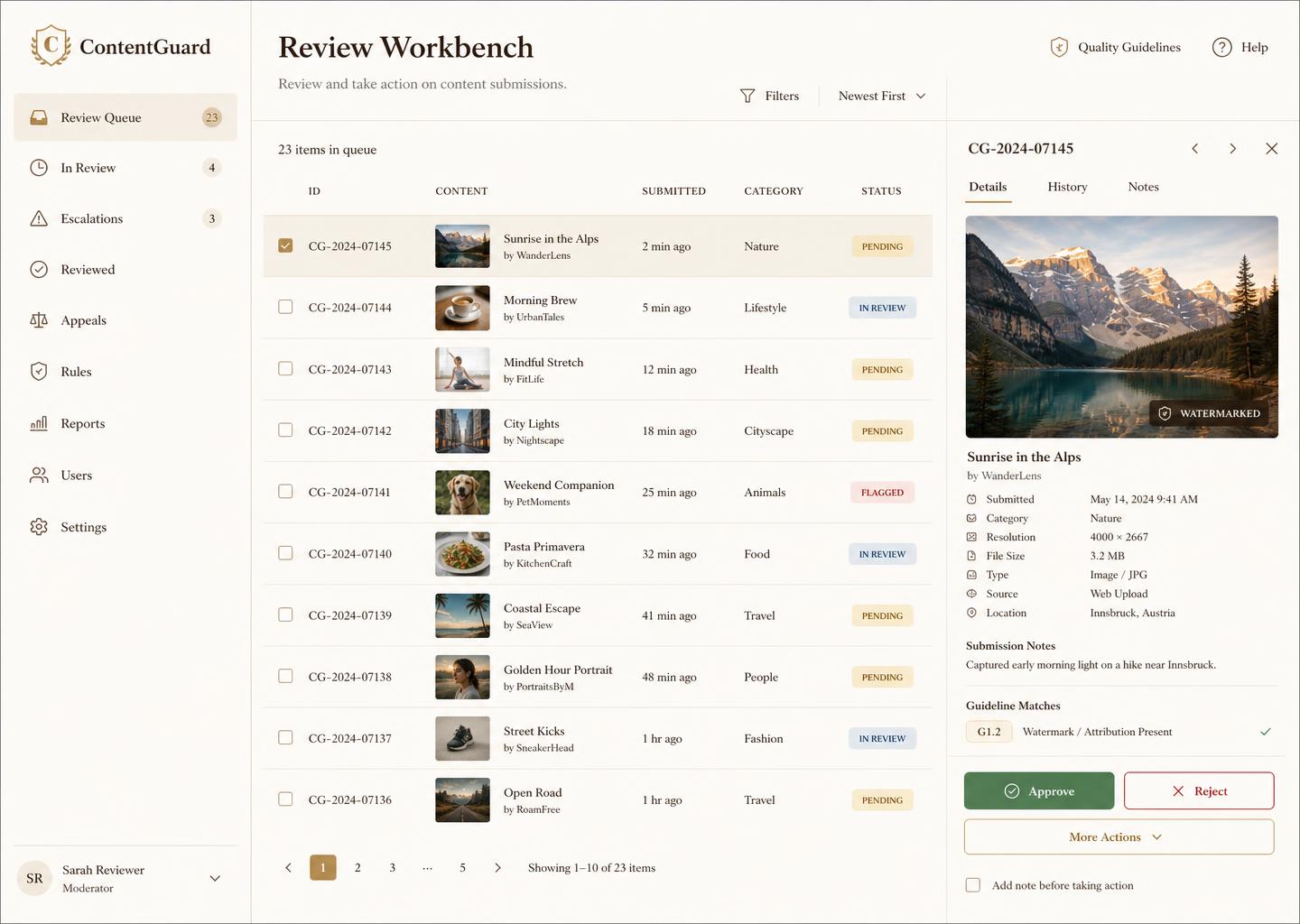
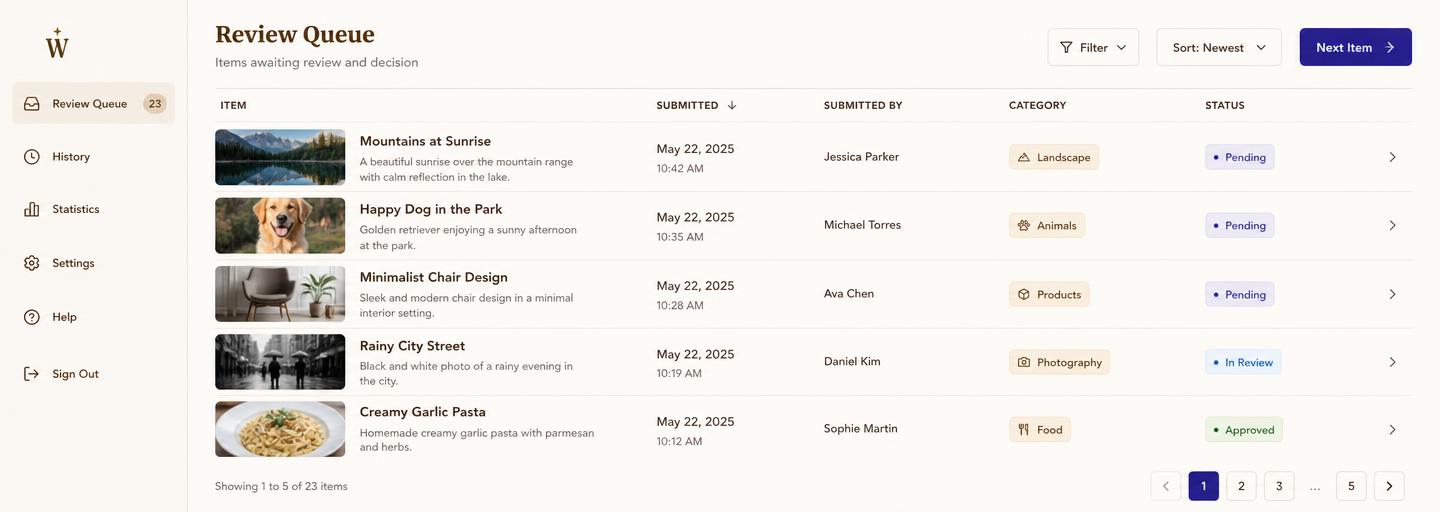
Concept demonstration, Chinese interface, fictional IP and data throughout.
Why now
AI has pushed the marginal cost of using an IP close to zero. A figure that looks like your flagship character, a classic film scene re-acted with a new face: ten minutes of work for anyone. Demand did not suddenly grow. The barrier disappeared.
Licensing was built for physical goods and human approval. One SKU used to take four approval rounds on a quarterly rhythm; AI generates by the minute. Two clocks that far apart break in three places: freeloaders get through, paying users find no door, and the licensor has no team for any of it.
Regulation closed the window. China's labeling measures for AI-generated content and the mandatory national standard GB 45438-2025 took effect in September 2025: generated content must be identifiable and traceable, and non-compliant apps have already been delisted. Compliance moved from bonus to entry ticket.
One system, four faces
Ten business lines run on one delivery stack. A licensor never opens all ten. Which line to enter through, and how far to open, is set per IP, per character, per moment.
Openness is a dial, not a policy. A flagship can run protection only. A new character at launch turns the dial to public creation for a window. Mid and long tail characters earn on templates all year. The licensor's hand stays on the dial.
Protect保护
Enforcement loses money because evidence is expensive: about eighty percent of traditional enforcement cost goes to proving the infringement, and takedowns multiply faster than filings. Three things change the math. Every legal output carries an invisible watermark, a birth certificate. Third-party evidence deposit makes the record court-ready. Fingerprint monitoring works from the licensor's master assets, so it hits AI output and pirated photography alike, on any platform, from any tool. Evidence work turns from hunting into lookup. And unauthorized use is unpriced demand: in YouTube Content ID's public data, over ninety percent of claims are monetized rather than blocked, with cumulative payouts past 12 billion USD through 2024. Caught cases split three ways: take down, convert, license.
Create生产
Controlled creation runs in four radii of trust, inside out: your own teams, your licensees, your manufacturers, your co-brand partner. Your own designers speed up inside your own guardrails first, which doubles as the proving ground for the rulebook at zero external risk. The licensee sandbox is the main course: guardrails intercept at the source, AI runs first review, TP human reviewers work on SLA, the licensor holds final approval, and nothing exports unapproved. Derivative development extends the same flow to physical goods, concept to approval in days instead of weeks. Cross-IP collaboration stacks two rulebooks, runs dual guardrails and parallel sign-off, with TP in the neutral reviewer's seat that neither a platform nor either licensor can occupy.
Monetize变现
Mid and long tail characters become controlled templates that brand-side buyers call and pay for, with billing and revenue split handled on-platform. Flagships never enter the template store; flagship licensing stays one deal, one negotiation. At launch moments, campaign amplification opens designated characters and scenes to public creation for a fixed window. A public precedent put scenes from three classic Stephen Chow films into controlled templates, letting ordinary users act alongside the characters. The gates hold: time-boxed windows, designated scope only, a watermark on every output.
Foundation底座
Everything starts by turning paper rules into rules a machine can read. Style guides, character sheets, and years of approval rulings live in PDFs and senior staff memory. Rules engineering translates them: one principle like "characters of different attributes never mix" becomes a detection rule, a combination whitelist, and a human escalation trigger. A flagship character typically settles at several dozen to over a hundred such rules. Every rulebook version ships with a labeled test set and baselines for false kills and misses: acceptance runs on numbers. Rulings flow back as new rules, so the rulebook grows with the IP. And the rulebook's intellectual property belongs to the licensor. If you leave, it leaves with you.
The delivery stack
围栏规则 · 监修队列 · 水印存证 · 指纹监测
Guardrail rules intercept at generation. The review queue routes AI first-pass and human judgment on SLA. Watermarks and evidence deposit give every legal asset a verifiable origin. Fingerprint monitoring watches the open web from the master assets outward.
How the lines feed each other
Campaigns make noise; strays get caught by monitoring. Monitoring triages; the convertible cases become template or sandbox customers. Creation lines produce the compliant content that arms the next campaign. Every ruling flows back into the rulebook. The longer the system runs, the thicker the rulebook, the lower the false kill rate, the higher the cost of switching away.
Where licensors enter
A phenomenon-level toy IP usually enters through protection, holds the line with the licensee sandbox, and opens public creation only in launch windows.
A character-library licensor builds trust on internal acceleration, makes the sandbox the main line, and puts the tail on templates.
A film library leads with campaigns and templates, with monitoring riding along.
Across markets
Chinese IP going out and overseas IP coming in hit the same wall: AI compliance differs by market (China's labeling measures, the EU AI Act, Japan's Agency for Cultural Affairs guidance), and so do the grey-market ecosystems. TP operates in close to one hundred markets; supervision and enforcement run in local time zones, local languages, local rules.
Roadmap, sold as roadmap
Dispute support and content liability insurance sit on the roadmap. Operating records from watermarking, deposit, and review will one day support liability determination and underwriting. We do not sell this today.
Engines and partnership
The system is platform neutral and runs multiple generation engines; engine choice follows the client's requirements and quality acceptance.
About the team
TP Infinity is part of TP, a global operator of customer experience and trust and safety across close to one hundred markets. The APAC team has run CRM and consumer operations for premium brands for years, and carries front-line licensor experience in online product approval and style-guide enforcement for a global top licensor.